A Rate Buildup Is Not a Guess Dressed Up in a Spreadsheet
Pricing Construction Works
Every tender is won on a number, yet very few individuals can tell you exactly where that figure originated. Two unit rates can look identical on a bid comparison sheet while being products of entirely different processes: one genuinely built from first principles (labour, plant, material, and site conditions), and the other arbitrarily adjusted downward to hit a competitive target. Only one is a true rate; the other is a guess disguised as data.
Establishing a defensible rate requires strict discipline and a multi-layered approach rather than shortcut estimates.
1.0 What a Rate Actually Needs to Contain
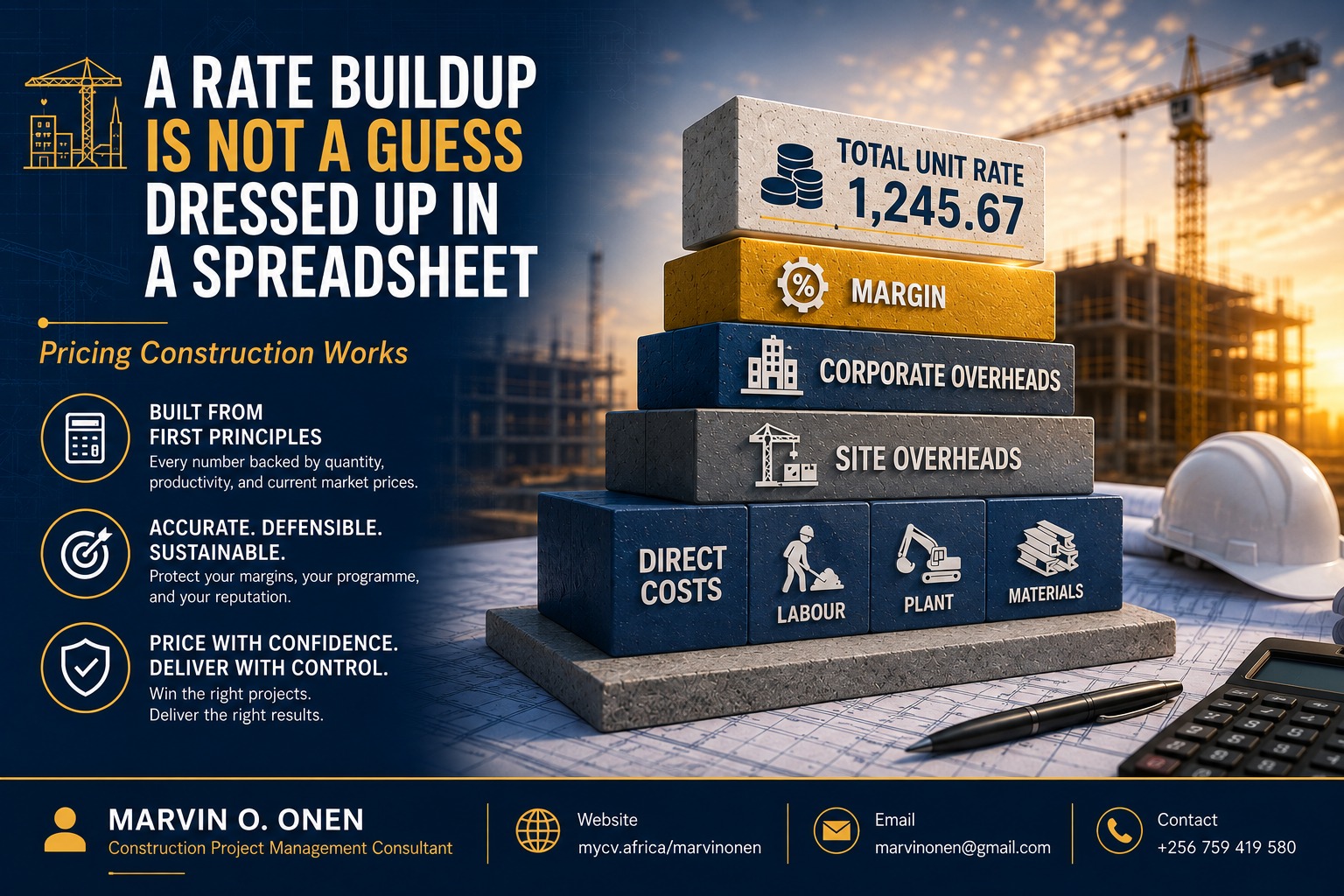
A robust unit rate is constructed in distinct layers:
- Direct Costs: Linked directly to the specific unit of work, including realistic labour crew outputs, plant expenses (accounting for standing time as well as active hours), delivered material costs with proper wastage factors, and genuine subcontractor quotes.
- Indirect Costs: Expenses driven by the existence of the project rather than a single task, encompassing Preliminaries and General items (supervision, site offices, temporary works, security, and transport) and corporate overheads (administrative staff and office running costs).
- Profit and Contingency: Applied deliberately as a margin on top of the full cost base, rather than obscured within individual line items.
Omitting any of these layers creates an incomplete buildup that invariably resurfaces later as an unbudgeted variation claim, a commercial dispute, or an absorbed site loss
2.0 Building a Rate From First Principles
A rigorous first-principles approach ensures every element is accounted for explicitly:
- Extract exact quantities directly from drawings and specifications.
- Apply realistic productivity rates derived from verified site data.
- Price materials, labour, and plant at current, tender-time market values.
- Incorporate activity-specific wastage and resource standing time.
- Account for risk and contingency explicitly, evaluating site-specific uncertainties, supply chain volatility, or operational constraints rather than hiding a random buffer at the bottom of the bill.
- Add site overheads deliberately, either as a separate bill or a calculated percentage, not a default figure out of habit.
- Differentiate clearly between markup (percentage added to cost) and margin (profit divided by selling price) to avoid inadvertent under-pricing (a target 25% margin, for instance, requires a roughly 33.3% markup on cost).
A properly built rate survives scrutiny from a Client’s commercial team because every layer is fully traceable
3.0 What a Defensible Rate Protects
Diligent rate building serves as a vital safeguard across multiple facets of project execution. By establishing realistic productivity assumptions, it protects the programme from the need for forced and silent schedule compression. Furthermore, accurate pricing preserves the client relationship by preventing aggressive, friction-heavy variation claims down the line. At the enterprise level, it protects the business by ensuring corporate overheads are fully recovered rather than bleeding into future contracts. Finally, explicit margin calculations protect the bottom line by securing the intended financial return rather than letting hidden gaps erode profitability.
4.0 The bottom line
A rate buildup is much more than a routine tender formality, it is the primary mechanism that guarantees a project can cover its direct costs, site overheads, corporate expenses, and genuine profit before a contract is ever signed. The contractors who price accurately are not the ones who win every bid. They are the ones who do not lose money on the ones they win, because nothing in the number was ever a guess.